Wednesday, May 31, 2006
More pictures!
 A Giant Panda - Duh!
 Leshan Dafo, the 71m Buddha at Leshan
 Monastery monkeys on Emei Shan
 The Chinese sure know how to spoil a pretty sight. This is the popular summit of Emei Shan, but not the true summit.
 The obligatory summit photo from Emei Shan's true summit, Wanfo Peak (3099m). The person who isn't me is Michal, my partner on this hike.

Giant water wheels in Lijiang
 Tiger Leaping Gorge, from the high route. You can see the Yangtze at the bottom of the gorge.

May 31: Even more Hong Kong
The verdict: the spectator area is way too far away to appreciate dragon boat racing. I think you have to be doing it to really enjoy it. Plus, it was hot and crowded. I watched a few races and left. The good news, of course, is that the ride into Stanley is quite scenic and the town itself is quite nice. Beaches, cafes, hills, trees, etc. Very nice.
Since I still had half an afternoon to go, I went to the remote settlement of Shek O, also on the island. "remote" in this case means "45 minutes by public transit from the financial centre of Asia". For comparison's sake, I sat for more than 8 hours on a bus from Kunming to Lijiang, and that's not "far" by Chinese standards.
The verdict on Shek O is that it's really very nice. It's tiny (3000 people live there), has a nice beach. You can go for a little walk onto a peninsula outside the town and soak in some ocean air. Plus, to get here you take a scenic, winding mountain road and enjoy some really nice scenery that is literally around the bend from.... the financial centre of Asia.
All this leads me to one conclusion: I really like Hong Kong, and I think I'd enjoy living here someday. Maybe in a few years I can be an expat in HK. What sets Hong Kong apart from other places I've really liked is that it has a nice mix of greenery and nature and pretty things, while at the same time being a very vibrant, very active, very fast-paced place. Oh, and there would be work for me here. This is a market difference from, say, Juneau AK - where the scenery is terrific but there's nothing for me to do work-wise.
Also, consider this: Hong Kong is very centrally located within Asia. It's a stone-throw away from places like Lijiang (through a flight out of Shenzhen). It's a 5-hr flight to Delhi, and probably a 4-hr flight to Kathmandu. It's close to Australia and Japan. About the only thing I couldn't do here is ski, but then again an airplane can take me to New Zealand or Japan or even northern China for a ski fix.
Plus, if I was ever to move here for work I think the cost of living thing wouldn't be such a big issue. It seems like a lot of people here seem to do pretty well for themselves.
Tuesday, May 30, 2006
May 30: More Hong Kong
Anyway, The Peak was was a bit of a ledown. I walked down, got my pictures, found and internet cafe and the previous post is the result of this amalgam of activities.
Incidentally, I also went for my second fitting of menswear today. The verdict: amazing. The suit rocks, the sport jacket rocks, everything fits great, etc etc. I am happy. Now I just have to figure out how to pack it all for the flight to Delhi.
I also picked up an altimeter watch. When I start the trek (next week) it'll be able to answer the eternal question I've been asking myself all the time in Tibet and Yunnan: "how high is this bloody place?" It cost rougly what it would cost in Canada - though of course 15% less seeing as Hong Kong has no sales taxes. Some things are cheap in Hong Kong, some things aren't. When it comes to gear, it seems to cost the same money as in Canada - or sometimes more.
Tomorrow there is a dragon boat festival and I intend to make it out to the town of Stanley (on the island) to watch some dragon boat races. Should be cool. Also, I'm done shopping and I'm going to make an effort to put a cap on spending for the next two days. I think once I'm in Delhi and settle my trek bill, my costs will be very near zero, which is a nice contrast to Hong Kong.
Pictures!!!!!!

The Great Wall at Jinshanling

The Grand Mosque in Xi'an, China's biggest mosque
 Tibetan schoolkids!
 This Tibetan woman didn't know what was coming. I hope she doesn't mind being immortalized.

Potala Palace, with a stupa in the foreground

Monk Debates at Sera Monastery

Samye Monastery

Yamdrok Tso, a high altitude lake on the road to Gyantse

The view from Gyantse Dzong

Gyantso La, 5220m

Makalu (8462m, 5th highest) on the left. Taken from Pang La

Mt. Chomolangma (8844.33m by the latest measurements) mid-afternoon on May 8th, 2006

Mt. Chomolangma on the morning of May 9th, 2006

I live a hard life. I really do.
Monday, May 29, 2006
May 29: More Hong Kong
This morning, I ordered the following clothing from a taylor:
- One two-piece suit, in a fabric that says Big Swinging Dick.
- One sport jacket, also designed to look like it belongs to a Big Swinging Dick.
- Two pairs of pants
- Three shirts
The whole kit is setting me back the cost of a good off-the-rack suit in Canada, if purchased somewhere other than Harry Rosen. Alternatively, it is less than the cost of a crappy suit at Harry Rosen.
I also located the professional photo district in town and got some of my film developed. The good news is that the film I accidentally checked into my baggage for the Chengdu-Kunming flight appears to have survived unharmed. The bad news is.... the internet cafe by my closet (wait, I mean "hotel room") has computers with no CD drives. So no posting of pictures. This is really getting on my nerves.
Also, today I bumped into a wandering Yogi from India. He did some sort of trick where he read my face and wrote some things down (encoding my wishes and problems and whatever) without showing me what he wrote. I held the paper. He then asked me questions and wrote appropriate things on a piece of paper that I did see. For example, he wrote "P-CW" for "problem - crazy women". He said if the writing on the paper in my hand matches what he noted down then I'll be blessed with good fortune, success, and no more crazy women in my life.
Well, the good news is that the papers miraculously matched. No more crazy women. I don't get it, since it's not clear to me how he could have pulled the trick considering I either had the face-reading paper clenched in my fist, or had my eyes on it the whole time. The bad news is that he wanted an absurd amount of money for his service. I don't know what the consequence of pissing off a wandering Yogi would be, and I hope I don't find out.
Anyway, according to him I'm going to live a long & successful life, although he claimed the success is "moderate" as opposed to "massive" - something about a sun star or somesuch. I have no idea what any of this has to do with anything. But, now that I've read Holy Cow and learned about what happens to neurotic Australian women when they piss off a Yogi, I'll proceed with caution and accept that maybe I'll live a long & successful life.
Also, tonight I met up with a girl I worked on my AFM 476 cases with, and her very cute friend. The AFM 476 girl is doing zilch, whereas the cute friend is an investment banking intern somewhere in town. We had dinner and walked around. I might see them again tomorrow or the day after.
Tomorrow: more Hong Kong. The weather continues to suck, and the forecast calls for 29 degrees and thunderstorms. Wonderful. I was going to climb The Peak (all 500m of it) and catch views of the skyline, but if the weather is craptacular then there doesn't seem to be much of a point to doing that.
I leave for Delhi on Thursday, and already have brunch plans for Friday morning.
Sunday, May 28, 2006
May 29: Hong Kong!
- My CITS contact (CITS being the Chinese national travel agency), Mr. Huang, appears to be in Hong Kong today. I briefly talked to him yesterday saying "I'm coming to Shenzhen tomorrow, I need my ticket" and the conversation died (due to my lack of cell phone funding at that moment) before anything could be settled.
- Shenzhen was ridiculously rainy. I mean torrential downpour. Disgusting. I walked around in this horrid weather with an 80L pack on my back, and a 35L daypack on my chest, wearing my superatomic Mountain Hardwear Backcountry Recon Parka (everyone should have a jacket like this). Every time I walked into a place to ask for directions or something, people looked at me with this combination of Shock & Awe. Shock because I was a white Westerner clearly loaded down and absolutely drenched with water. Awe because I think none of these Chinese could imagine being in my shoes. They carry umbrellas to shield themselves against the sun, for cryin' out loud. I think they might be really terrified of rain. Maybe they felt pity for me.
- The CITS office is actually closed on Sundays, a fact that I was not made aware of until this afternoon.
By good fortune, I managed to make my way to the right approximate area for the closed CITS office. By more good fortune, on my 6th attempt to reach someone at the office, a human who speaks English picked up and explained that the office was closed. He then directed a taxi driver to his apartment building where he met me ticket in hand. Finally, I completed the process of moving my flight to India to a day earlier. The final leg of this operation took about an hour and a half of walking around in monsoon-like rain. The good news is that I now have a way of getting to Delhi, and I also know that my giant backpack is, in fact, more or less rainproof - if the contents didn't get soaked in today's hurricane-like rainfall, they won't get wet in ordinary rain either.
Anyway, I crossed the border into Hong Kong without trouble and got to the city (the Kowloon side) at around 3 PM. I don't understand this "border" thing very well, considering Hong Kong is actually a part of China. However, under the "one China, two systems" policy it seems like Hong Kong gets to act like a sovereign state in many of the ways that count. Hong Kong has its own currency, for instance - and it also doesn't seem to be affected by the Great Firewall of China. Macau, the former Portugese colony and current Chinese gambling haven, also has its own currency. Weird.
My impression of Hong Kong is that it's something like the London of Asia. It's a city for Big Swinging Dicks and Dickettes. However, unlike London, a wannabe-BSD like me can actually afford to buy things here. That said, it's way more expensive than any of the places I've been to in China. For instance, a single room here costs me 160 HKD per night (roughly 150 kuai), whereas a bigger and better room cost me 50 kuai in Lijiang, and a totally swank room cost 150 kuai in Lhasa.
Speaking of which, the room I'm staying at is so small I think I could touch each of the four walls simultaneously. I might even try to do exactly that tonight. I've literally stayed in tents that were bigger - notably the giant Mountain Hardwear Space Station we slept in last summer on the Mendenhall Glacier. Ahh, good times....
Anyway, just like London is the posh luxury shopping capital of Europe, Hong Kong is the same for Asia. There is a shopping mall here featuring such retailers as Louis Vuitton, Prada, Fendi and Versace. There's opportunities to spend big bucks, galore. The same stores exist in other cities, like Chengdu, but the scale here is just staggering. Simple things are more expensive, too. For instance, street food is on average 3x more expensive in Hong Kong than elsewhere in China. Restaurants of the "10 kuai dinner" variety don't seem to exist here. For instance, today I somehow managed to spend 160 HKD (150 kuai or so) on dinner because I was in the part of town that doesn't have much cheap food - Causeway Bay, on the island. The upshot is that the same meal would have cost triple that amount in Canada, and I was served by a beautiful Chinese girl with gorgeous long black curly hair. Mmmm.......... long black curly hair....
So yes. Things are relatively expensive here, and I'm suffering from sticker shock after being spoiled by being able to live like a king on peanuts in the rest of China. Of course, if I had come straight from Canada I would be creaming my pants at how cheap everything is. What's also interesting is that some things are actualy more expensive here than they would be in Canada. For example, an Arc'Teryx pack I spotted in a gear shop (RT35 - I really want one) is about 50% more expensive here. Bummer.
Also, the scale of Hong Kong is unbelievable. The place is actually pretty big considering how built up it is. Hong Kong Island has a skyline that makes you jaw drop, and I saw it through fog! There are countless enormous beautiful skyscrapers. There are fancy restuarants everywhere (including a Morton's, Big Swinging Dick central). There is an enormous number of shops where you can buy almost anything, there are specialized markets for all kinds of junk (I don't think I want to know what they sell at the Ladies Market). There are people all over the place. A lot of the city is seriously modern. For instance, the subway here makes Toronto look like a clownshow, which I suppose it actually is. Many of the skyscrapers are new. There's neon everywhere. Sensory overload.
However, I should say that in the middle of all this there's lots of evidence of the seamy underbelly of Hong Kong. For instance, the building my guesthouse is located in, Mirador Mansions, looks ugly as sin. When you pass by it, you'd think it's ready for demolition, and going through the hallways only reenforces that impression - fortunately, the actual guesthouse part of the building is renovated and quite nice. People seem to be crammed like sardines in this place, and have to compete for living space with the ubiquitous McDonalds and Starbucks locations. I appreciate the latter, but not the former - and I've yet to set foot in a McCafe, whatever that monstrocity is.
Another similarity with London is that the drivers own the road, and pedestrians better watch out. This is not a city built for walking. If you think of crossing the road, you're likely to be stopped by either:
- A metal barrier.
- Your desire to avoid becoming a red splattery stain on the pavement.
- Both.
Road-crossing is restricted to overpasses and underpasses built for pedestrians. If you want to cross a street where there's no nearby overpass, your only option is climbing over the metal anti-pedestrian fences that line the roads and being very brave. There aren't as many cars here as in Beijing, Xi'an or Chengdu, but they drive much faster because they don't have to worry about pedestrians or cyclists with giant Beijing-style cojones.
I'm also somewhat bemused by the fact that I can get by here with English, since almost everyone speaks at least some English. In the rest of China, you're sometimes hard-pressed to find an English speaker, and if you want to buy yourself a bottle of water you better be ready to point and pantomime unless you can mumble "wo yao shuey" in a way that the native spaeker can understand, and then comprehend that when the storekeeper mumbles "liang kuai wu" in the middle of other incoherent rambling that is a signal for you to fork over 2.5 kuai. Here's everything's much simpler; they say "8 dollars" for the same bottle of water and you fork over the 8 HKD with a feeling of helplessness and resignation.
Tomorrow is my first full day in Hong Kong and I intend to spend part of it picking out a taylor to have some clothes made. I'm not a Big Swinging Dick, but maybe I can at least look respectable at work from time to time. Tayloring is actually quite cheap here, and seems to be monopolized by the South Asian community. Every taylor that accosted me on the street today (and there were quite a few) appeared to be of Indian/Pakiskistani/Bangladeshi origin. It might be a racket.
Saturday, May 27, 2006
My China adventure is coming to an end
- I walked 10km on the Great Wall.
- I got to admire the creepy embalmed body of a murderous dictator. Mmmmm.
- I spent two days wandering around the Muslim Quarter of Xi'an.
- I climbed partway up Pumbo Ri, a mountain near Lhasa, on my second day there.
- I saw some of the important monasteries in Tibet, including Drepung, Sera, Tashilhunpo, Samye and Yumbu Lakhang.
- I spent some time one-on-one with a monk from Drepung, and taught him some English in exchange for learning how to pronounce "four" in Tibetan. Oh yeah, and he gave me a pretty unique book.
- I wandered the Barkhor for countless hours. I learned to bargain like a Tibetan.
- From the top of Pang La, I saw Everest, Lhotse, Makalu and Cho Oyu all at once. I nearly passed out from a mixture of elation and low oxygen.
- I slept a night at Everest Base Camp. Oh man, was it ever cold.
- I acquired the pants of a climber from Ecuador, and I seem to have an invitation to go there and climb Cotopaxi with him.
- I saw pandas! I want to be a panda.
- I climbed Emei Shan and admired the concrete hell on top.
- I hiked the Tiger Leaping Gorge!
- I bushwacked for a few hours in the name of a glorious view of Lugu Lake.
- I climbed to the summit of Zhonghe Shan (4092m) from 2700m in 5 hours. In the rain. With no view of anything whatsoever. This was a hike strictly for the love of hiking, and maybe to satisfy some masochistic desires.
- I discovered that despite my rather mediocre cardiovascular health I seem to adapt well to altitude. Maybe I'm fitter than I give myself credit for.
- In the middle of all this, I still managed to find time to kick back, relax, sit in teahouses and chat with people. I'm on vacation, after all.
Above all, I met amazing people everywhere I went. The list is long, but some of the highlights include:
- Katie, with whom I shared a romantic moment in the Maosoleum, wandered around the Forbidden City and spent an evening in Chengdu. She was the unfortunate recipient of some dog bites. But, being a trooper, she's coming trekking with me in India after some salesmanship on my part.
- Guani and Leticia, my Xi'an girlfriends. We spent two days getting lost in the city, and it was great.
- Julien, my Lhasa travelmate for half the time I spent there. We spent many hours exploring town together and seeing the monasteries nearby. We also had a pretty unforgettable trip to Samye on a pilgrim bus. I hope to see him again in Hong Kong... tomorrow!
- Caroline and Demelza, two of the three people I went to Everest with, were really great to share a jeep with. The same can't be said for Megan... but that's all past.
- Patricio, the Ecuadorian climber whose pants I now guard jealously. Maybe a year or two from now we'll meet in Ecuador.
- Doug, the owner of the Everest Summit Cafe in Lhasa - a unique businessman, with a unique business in a unique town. 'Nuff said.
- Michal, my climb-mate for Emei Shan. We had some pretty unforgettable days on Emei Shan and in Chengdu. 'Nuff said.
- Mama & Papa Naxi - they run the best backpacker guesthouse in the world as far as I'm concerned. I'd gladly live there for a year.
- Hummus, Theena, Pita and the rest of the Tiger Leaping Gorge crowd. That was one seriously fun hike.
- Miky and Jean-Brice, who were on the trip to Lugu Lake and did a great job of bushwacking in the dying hours of the day. In hindsight, going on that hike at that hour wasn't terribly smart - but it was terribly fun! Miky is a Japanese chef and wants to open a cafe in Lijiang. I wish her all the success in the world.
- John and Meike, who I climbed Zhonghe Shan with. This Dutch couple is definitely among the best hiking partners I've ever had.
Now, the trip is not over yet, but I'm definitely leaving China tomorrow (unless something goes terribly wrong and I have to spend a night in Shenzhen). It's been a really great time. I've learned a lot about the way this part of the world operates, and a lot of what I've seen surprised me. Some of it has been good (like the warmth and kindness of the Chinese, Tibetan, Naxi and Bai people) and some of it makes your stomach turn (like the dirty, noisy, polluted cities, or the way the Chinese seem to like to spoil wonderful scenery by putting TV towers everywhere).
If you're reading this and thinking "man, this trip sounds so cool" then stop sitting on your ass and book a flight. Travelling through China is dead simple, and doesn't have to cost very much. They love foreigners here. There are backpackers everywhere, and you definitely meet interesting people. There is a lot to see, It's a huge place and has something for everyone. I've been here for five weeks now, and I feel like if I had another five weeks I'd still only scratch the surface of China.
I'm not sure when I'll be back here, but I'd like to come back some day and see more places. I still want to make a pilgrimage to Kailash (but I have to sin more first, since there's no point in wiping away the sins of a lifetime until you've had a chance to rack some up). I still want to see Jiayuguan, the Western end of the Great Wall. I can't make it to Guilin & Yangshuo this time around, since time is too short. I haven't been to the hanging temples in Datong, or to Tai Shan. I've been told by a reliable source that Kham is very cool, and it'd be very interesting to spend a bit of time in Qinghai. There's so much to see, and this is just one country!
Anyway, tomorrow I am on my way to Hong Kong. Even though it's technically China, it's not really China - I have to get rid of all my kuai and buy a bunch of Hong Kong Dollars. I hear the pace of life there is inline with my rather hurried lifestyle, and it'll be a nice change from the easy going in Lijiang and Dali. Next Thursday I fly to India, and a few days after that I'll be in the Himalayas. Yeah!
Friday, May 26, 2006
May 26: Zhonghe Shan, 4092m
The guesthouse, the Higherland Inn, is really very nice. The girls working there are wonderful, and they fed us a massive barbecue dinner. "Us" in this case was a Canadian couple from the Hammer, an older (retired) Dutch couple working in Chengdu (he's teaching MBA students, she's a bon-vivante) and another Dutch couple, John and Meike, who are on a trip around the world (destinatiosn they're already visited include Bolivia, Patagonia, Antarctica, New Zealand, and some others).
Anyway, when I got to the Higherland Inn I saw signs saying there was a route up to the nearby summit, Zhonghe Shan, that would take 5 hrs up and 3 hrs down. Zhonghe Peak is at 4092m, and you start climbing from about 2700m. The choice was to hike the trail the next day, or to see the Stone Forest on Saturday. I hummed and haa'd a little bit and then I got a random phone call from Katie who said "go hike!" and that's when I had the epiphany: I'd rather spend a day climbing the mountain than a day going to another tourist trap, no matter how nice.
Later that night two guys showed up at the guesthouse looking haggard. They came and disappeared, and I found them in my room sleeping on the two spare beds. Turns out they went up the mountain that day and near the summit both started to feel the altitude quite badly, and had a nasty descent that incorporated a fair bit of puking. Altitude sickness is not fun.
The next morning (the 26th) John, Meike and I set off around 8 on this hike. There are only a few words to describe the trail adequately: steep, long, and in places a bit technical. For instance, there is a substantial section of the trail that goes over some boulders, which are both steep and have very few footholds. You can't get around the boulders, and you really don't want to fall. Plus, it rained in the morning, so the vegitation was wet, and in the afternoon it started pouring rain. Hiking at its best.
We made the summit in just under 5 hours, and took another 5 hours to get down. In other words, we climbed about 1400m (4600 ft) in 5 hours - not bad. I spent most of the day in the lead, setting pace - it worked out very well, since all three of us were roughly the same level of fitness and walked at roughly the same pace. It was a very long, very consistent 5 hour ascent. What's at the top? Typical Chinese horror - a TV tower of some sort (really a sattelite dish) and an ugly building. The people in the building were unfriendly and claimed not to have any tea when I asked. It's like a good movie with a bad ending.
The way down was long, wet and pretty rough. The aforementioned boulder sections of the trail were quite tough to get down, and took a very long time - I was in the lead, so I got to make the mistakes and show Meike and John what not to do. I also got to be the one figuring out the best way down the rocks, which in a lot of ways was kinda fun. However, it was definitely hard. Whereas going up is a matter of being physically fit enough, the way down is a matter of concentration. The trail is slippery and steep; a misstep can lead to a sprained ankle or a nose-dive into the mud or the bush or something.
The verdict is that the trail is awesome. In a lot of places it reminded me of hiking in Southeast Alaska: a forest-covered mountain trail, and very wet. John and Meike were terrific hiking partners, too. I think I've had more physically exhausting hikes (like the Tiger Leaping Gorge) but I don't think I've ever hiked a trail that was quite as technical. It was great fun. The Stone Forest can wait.
Today I'm taking a bus to Kunming, and the next day I'm flying to Shenzhen and taking a train to Hong Kong. Then, I'm off to India. Two weeks from today I'll be walking through the Indian Himalaya with sun in my eyes and a smile on my face.
Wednesday, May 24, 2006
May 23-24: Lugu Lake
Lugu Lake is a large alpine lake on the border of Yunnan and Sichuan. It was advertised to be a 6-hr bus ride from Lijiang, when in reality it takes 8 hours to get there. By bus. The upside is that it's 8 hours of looking at stunning, gorgeous, unbelievable Yunnan scenery. Big mountains all around, deep valleys, gorges, wow. Stunning. But it's still 8 hours of bouncing around in a bus, and doing that as an overnight journey sucks. Moreover, getting there is quite expensive - 120 kuai for a roundtrip bus, and another 80 kuai to get into the Lugu Lake area, which is ridiculous and reeks of corruption. At least I got the 50% student discount.
The area around Lugu Lake is inhabited by the Mosuo people, which are a spinoff of the Naxi. The main neat thing about them is that they are one of the few remaining totally matriarchal societies in the world. The girls run the show. They pick the husbands. Moreover, if they want to leave the marriage they're free to do this at any time, and get to keep the property and kids. The man gets nothing. I wonder if he has to pay child support...
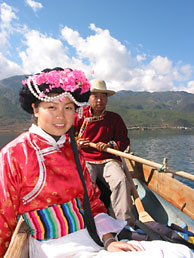 Anyway, the Mosuo people are very cool. They dress neatly. They seem to practice a blend of Tibetan Buddhism mixed in with something else - I definitely saw prayer flags and katas, although I didn't see any prostrating monks. Picture to the right stolen shamelessly from the web.
Instead of the main Lugu Lake village (Luoshui) we stayed at a smaller village, Lishi. This is not a village per se, it's a collection of construction and concrete hell. Fortunately, if you walk 500m to the nearby peninsula, you reach some nice wooden guesthouses and get away from the Chinese construction hell the bus dropped us off at. I should disclose that when we arrived and I saw where we ended up (we were at Luoshui village first, and opted to stay on) I nearly lost it because I was already on a bus for far too long and faced the propsect of leaving early the next day and not enjoying the place fully.
 Fortunately, the lake itself is very nice. Surrounded by mountains on all sides. The view is pretty awesome. Picture also shamelessly stolen from the web.
Near the guesthouse was a bay, and another peninsula which is effectively three small connected mountains. Jean-Brice and I looked at it and said "that's hikeable, maybe we can walk along the coast to the end." We decided to go and have a look at it that afternoon, and maybe hike it the next morning. Miky came along. We started walking at around 5:30 and made some good time. The coastline looked promising for a while, until we encountered a rock. Jean-Brice and I are both stubborn assholes who don't want to stop, and besides, we were having fun.
The following hour or so was a grueling, painful slog up bush-filled mountainside. No trail. No real idea of when we would reach the end. Total bushwhacking. Really tough. I was quietly thinking to myself "we better not be coming down this crap in the dark, or we're in real shit here." It was awesome.
At 6:30 we reached the end of the peninsula. The view is an incredible 360 degree of the lake. Stunning. At 6:45 we turned back, only this time we had a trail (the "Lugu Highway") along the spine of the peninsula. More bushwacking. More tough routefinding. We eventually came down to the beach we abandoned to find that Hebe, Gal and a small dog decided to be a private search party and make sure we were okay. I think they figured we don't know what we're doing, and I won't discuss the veracity of that claim.
Anyway, we were back at dinner by 8. The hike, though pretty short, made the 16 hours of travel all worth it. Moreover, this was only Miky's second hike, ever - the first being the Tiger Leaping Gorge. In a matter of three days she managed to do a pretty tough mountain hike in the Gorge, and a quick, difficult and absolutely gorgeous bushwacking trip. One hell of an introduction to being outdoorsy - I'm proud. She's hooked forever.
The next morning Miky & I boarded a bus back to Lijiang at 10:30 and suffered another 8 hours in a bus, consoled by more stunning Yunnan scenery. The other three folk stayed on another day in Lugu Lake, and they're all continuing elsewhere overland from there.
Other good news: Katie, the girl I met in Beijing and who suffered dog-bites in Kham, is almost certainly coming on the Zanskar trek with me. I guess my efforts to convince her weren't all for naught. Anyway, I'm pretty excited about this latest development. The trek is shaping up really, really well - and it'd be great to have Katie along.
Tomorrow I am heading to Dali, another town in Yunnan, for a night at a mountaintop guesthouse. The next day I'll be heading to Kunming, and I'm flying to Shenzhen on the weekend and taking either a train or a boat to Hong Kong. So much to do, so little time.
Monday, May 22, 2006
May 21-22: Tiger Leaping Gorge
I can tell you that if the tiger leaped and didn't make the other side, it's definitely in deep shit. There were some scary-looking rapids down there.
Anyway, we set off from Mama Naxi's on Sunday morning for a 3-hour drive to Qaiotou, the jumpoff point for the trek. 14 people left in two minibusses, both of which looked like they were going to crap out at the first excuse. Among the attendees were:
- Three Israeli guys, named Odad ("Hummus"), Nadav ("Theena") and Tal ("Pita").
- Brennan and Wes, a couple from Victoria.
- Dave and Layton, dudes from Australia who've trekked in Nepal for two months earlier this year.
- Sonia, a lawyer-to-be from Switzerland.
- For a trekker, Dave was walking quite slowly. Hmm.
- Hummus decided to go bushwhacking in the first part of the trip, got lost, and miraculously made an appearance, shirtless, late in the afternoon on the first day. In fact, Hummus had quite the look to him: sandals with the rear straps undone because of blisters, shorts rolled up for reasons unclear to me, scruffy beard, and a hairy chest. Mmm-mmm sexy.
- The hike has a part called the 28 bends, which should rightly be called the 28 painful horrifying switchbacks in pounding sunlight. But, the view from the top is magnificent.
- The Israeli crew came prepared for anything, which included bringing a stove to make tea on the trail, and bringing swimsuits to take dips in the mountain runoff. Hmmm....
We spent the night at a guesthouse that advertised hot showers and great food. The sign said "halfway house" which should have been a warning. All in all, it was very nice, except there were no hot showers. There were cold showers. COLD. Brrrrr... not what you need after a day of hiking.
The hike of the second day consisted largely of going down to the river itself, at a point roughly 2/3 of the way from our starting point. The family that built that section of the trail decided to extort tourists, so this cost money, but it's definitely well worth it. Why? Because the views are even more stunning. Fast, furious class 4 or class 5 rapids. A waterfall. A place to take a bath (if you're Israeli and a little nuts) or dunk your head in the icy water (if your name is Alex). Oh, so GOOD.
Now, this is where the plot thickens. From the magical spot by the river, we could have actually continued further along the gorge, and in fact four people set off ahead of us and did that. I stayed behind with the Israelis and with some other people, and we followed shortly (after paying a 5 kuai tax to the bridge troll, of course). The problem is that our fearless leader, "Pita" Tal, said "oh, we go this way" and took us away from the amazing route through the bottom of the gorge and up to the Sky Ladder.
Instead of some spectacular hiking that I heard about later in the evening, I got to do a hike that was the 28 bends all over again (though not quite as high) and climbed a very scary 20-30m ladder along the way. Yikes. We ended up near where we dropped into the gorge to begin with, and never managed to hike the whole gorge through. I was disappointed - but only when I heard about what we missed. Ignorance is bliss.
All in all, though, this was without a doubt one of the most spectacular hikes of my life, if not the most spectacular. Words can't do this place justice. Pictures might, and pictures are coming... but that's what I always say and never deliver.
I'm back in Lijiang, but I think I'll go to Lugu Lake tomorrow for another overnight trip. Alpine lakes good. I am on a tight schedule, and I aim to be in Hong Kong on Sunday or Monday.
Saturday, May 20, 2006
May 20: Lijiang
What bugs me is that this nice area is surrounded on all sides by a ugleeeee Chinese buildings. What bugs me even more is that the streets themselves are crawling with loud Chinese tour groups. And I really hate the way the Chinese pose for pictures in front of nearly anything. Grrrr....
I also went to the Black Dragon Pool, which is an oasis of peace and quiet. I think the 60 kuai admission deters the Chinese tourists to some degree, while any foreigner with a driver's license written in a different language can claim to be a student and pay half price. Nice.
 Anyway, the Black Dragon Pool is basically a park with a pond, some pagodas, and some expensive artwork shops that masquerade as museums selling Naxi art of various kinds. It's nice largely because it's quiet and has a great view of Yulong Xue Shan. I stole the picture from the interweb. Enjoy.
I also visited a museum-looking place put on by some American NGO that wanted have a self-gratifying (ie masturbatory) exhibiton of it's awesomeness. It's a building with displays of pictures depicting what this NGO does, although it's not totally clear what that is, exactly. I know that their Chairman shook hands with Jiang Zemin - there's a photo! It's a terrific waste of real estate.
The verdict on Lijiang: it's a lovely town to spend a few days relaxing. It's easy to get lost in the old part of town, since the streets are tiny and go everywhere. But, it is extremely touristy - much more so than Lhasa. Lijiang is as tourisy as Chengdu is flashy and cosmopolitan. I don't know if I can stand this town much more.
I'm staying at a guesthouse called Mama Naxi's, which is run by... Mama and Papa. They rock. I don't know how this woman hasn't dropped dead of exhaustion, since she seems to look after everyone's travel needs, arrange an enormous dinner for 30 every night, figure out where to pick you up when you get lost or arrive in town, among a myriad of other jobs. When I got in last night, she sent Papa to meet me at the bus station and take me to the guesthouse (I'd never have found it on my own). When I arrive, I'm told that the only room available is a gorgeous single room, with ensuite, for the unheard-of bargain of 50 kuai ($7 CAD). Oh the humanity!! Moreover, I got in kinda late (10:30) and when I arrived she immediately asked "Are you hungry?" and proceeded to get one of her minions to make me some dinner! I was a little floored.
This place is not in any guidebook I am aware of but every backpacker heading to Lijiang knows about it. It's simply amazing, a real diamond in the rough.
Tomorrow I am going on a 2-day trip to the Tiger Leaping Gorge. I hear people do it in one day, but I don't think I'll be one of those people. From what I gather, the Tiger Leaping Gorge is one of those places that should be savoured for a little while.
Friday, May 19, 2006
May 18: On dogs and alcohol
Today I saw Katie, my friend from Beijing who I will be seeing in Delhi. She was in Chengdu. Why? Because of a medical issue!
Here's a word of second-hand advice: if you're in Kham (eastern Tibet), beware of the dogs. Katie was apparently walking down a street in the evening, dismissive of the good advice from her travel-companion Drolma that was essentially "beware of the dogs, they're mean and nasty". She saw dogs coming her way. The dogs were not friendly.
Result: dog bites to the legs and low back. Stitches. 18 hour car ride to Chengdu to seek medical treatment. Rabies shots and the works.
OWWWWWWWWW!!!!!!!!!!
I feel very bad for Katie, she really got a raw deal. However, I gotta say I admire the attitude: "I don't wanna be here anymore, let me go back to Kham!!"
Anyway, we spent most of the evening cruising around Chengdu and catching up on what we've been up to in the past few weeks. Chilled in the park. Checked out the confucian temple. Drank tea at a very swank teahouse. Etc etc. Good fun. I see her again in the morning of June 2nd, in Delhi. Maybe she'll come on the trek with me, maybe not.
This whole incident rings a little bit close to home because I was agonizing for a while about whether or not to get a rabies inoculation before the trip, and in the end opted not to. I figured the risk is minimal. Well, it is minimal, except if you're in rural areas with wacko dogs. And, if you're in high-dog-risk areas, carry stones in your pocket, and a big stick. You could do the Churchillian thing of speaking softly and carrying a big stick, but given that dogs don't respond to soft speaking very well I think I'll just carry a big stick.
I came back to the Mix Hostel later in the evening to discover that Michal, my Emei Shan hike companion, as well as newfound friend and temporary roommate, had a bit much to drink. Apparently a group of Limeys were playing a drinking game and invited her in. They didn't explan that when you lose you don't have to empty your glass, but just have to drink a bit. Result: incredible drunkedness. I spent a non-trivial part of the night listening to the sounds of stomach contents being emptied. Ugh. Not fun..
I am currently in Lijiang, the capital of the old Naxi (pronounced na-shee) Kingdom. The Tiger Leaping Gorge is here, and the scenery is generally pretty amazing. Mountains, greenery, very swell. I'm going to spend today tooling around town, and intend to go on a 2-day hike through the Tiger Leaping Gorge tomorrow. Updates will come... later.
This week I have a bit of a tight schedule since I would like to be in Hong Kong by Monday at the latest. Apparently the day before I leave HK is the Dragon Boat festival or something - I'm in luck!
Wednesday, May 17, 2006
Retarded computers
Problem: this computer does not have a working CD drive. No computer at this guesthouse does. I can't believe this abject stupidity. Also, I hesitate to use a Chinese internet cafe for more than about 20 minutes because doing that greatly heightens the risk of lung cancer.
So no pictures for now. Sorry.
Tuesday, May 16, 2006
May 14-16: Leshan Dafu & Emei Shan
First things first: The Great Buddha at Leshan is really, really big. I can't stress this enough. It's huge and massive and must be respected. Leshan Dafo is also located in a pretty nice park where admission is expensive, the grounds are well-kept, and Chinese tour groups go wild like angry monkeys. I love tour groups. More on monkeys later.
There's not much more to say about Leshan Dafo other than the fact that the scale of the thing impresses me. It's a 71m statue of a sitting Buddha, carved into the sido of a mountain. All around it are little temples with more carvings of various things. Pretty cool. Worth 120 kuai? No. Worth the 60 kuai price I paid? Sure.
Emei Shan is one of four super-holy Buddhist mountains in China. They say that Emei Shan is the highest (3099m) but I think that's a crock because they are forgetting Kailash, which is way holier and is 6700m or so. The signifiance is that apparently some dude called Puxian came up the mountain by elephant. Whenver the elephant farted, they built a temple. I don't get it. The mountain itself is located in southern Sichuan, about 2 hrs away from Chengdu and maybe half an hour away from Leshan. Visiting the Buddha and continuing to Emei is a popular route. Not surprising.
My original and highly ambitious plan was to make it to Emei by early afternoon, climb for a solid 5 or 6 hours until we get pretty high, and have a summit day the following day. Back to Chengdu after one overnight stay on the mountain. This plan was... unrealistic. Leshan Dafo took a bunch of time. Eating lunch there took a while (and included a demonstration of how the Chinese kill fish - by throwing them on the concrete steps!). The travel took a while. We didn't get to Emei Shan until about 4 pm. Fine.
A 9 kuai bus up the mountain to Qinyin Ge (about a third of the way up, and bypassing the boring lower parts) and we were off. I was told there were lots of stairs. I had no idea. I've never seen this many bloody stone steps anywhere. At around 6 pm we made it to Wannian Si ("Wannian Temple") and decided to call it quits for the day. It was clear that there was no way we'd be able to do this climb in two days. That's okay, since there's lots of accomodations on the mountain.
I should also say that I was at a huge unfair advantage on this climb over poor Michal. I just came back from Tibet and my lungs are used to having way less oxygen. I could pretend to be fit, when in fact I think I'm pretty average. But it's nice to know that I can run up stairs after I subject myself to altitude!
Next day: 25km of walking, more uphill, more bloody steps, and an exciting monkey incident, too. Emei Shan is crawling with monkeys that look like a cross between a chimp and an orangutan and a rabid dog. Some are friendly (like those at Xixing Chi, a monastery near the top). Some, like the rascal we met, were not. This little guy decided that the empty bag of snackage on the side of Michal's bag was, in fact, food. The monkey decided to get hostile, start hissing and otherwise act like a total prick. I threw a rock at it and missed. Michal handed me my trekking pole (aka "Monkey Stick") and positioned me such that I was a human shield against the monkey.
How do you tell a hungry, angry monkey that you'd really rather be left alone? "Nice monkey, please piss off and harass someone else" won't work because they don't speak English - it's a Chinese monkey and I don't know how to say it in Mandarin. No, what seems to work is taking the trekking pole, pretending it's a baseball bat, waving it around ominously and roaring like a tiger. The monkey hissed back. I waved and roared some more. The monkey turned tail and ran. Michal stood behind me amused in the extreme. I felt like a total king of the jungle. Alex, the Monkey-Frightening Alpha Male. Yeah!
Anyway, the day ended with more stairs (many, many bloody stairs) and a hotel room near the touristy top of the mountain. Apparently mid-May is the "low season" around here and rooms that are listed at 460 kuai go for 100 kuai without so much as a blink of an eye. Good enough for me.
May 16th, Summit Day. More stairs, except this time with tourists. Everyone seems to want to go to the so-called Golden Summit (3077m), which consists of a golden statue of Puxian, a big golden-roofed pagoda that looks like it was built last year, and a lot of concrete and construction. Oh, and there' s a huge, ugly metal antenna structure right next to the statue. Add to this some loud obnoxious Chinese tour groups. The result: horror. I have no idea why anyone would want to spend more than about 20 minutes up here, but the Chinese seem to love it. They pose in front of the antenna and try to look cool with their permed hair and their V for Victory hand gestures. Oh yes, and to make this morre touristy there is a cable car that takes you to the top, a number of posh hotels, a restaurant, shopping, and construction of every imaginable variety. I want to puke.
The nicest place to visit at the top of Emei Shan is the true summit, Wanfo Peak (3099m) which requires a 60 kuai ride on an ugly monorail and a quick climb. You are rewareded with a bit of solitude (not many tourists go here), amazing views, and a very nice isolated pagoda at the peak. It's well worth the trip just to have relief from the carnival around the Golden Summit.
Other observations about Emei Shan:
- I hear that the monkeys normally come marauding in packs and not as individuals. Maybe I got lucky.
- If you are weak but rich, you can actually pay to have a pair of Chinese dudes carry you up the stairs from place to place. The whole mountain could probably be covered for 1000 kuai. However, the sedan chairs they use to carry you look about as comfortable as an enema administered by the Marquis de Sade. There's no way I was going to be carried up.
- The existence of the cablecar and a road is actually very helpful for those of us trying to get back to Chengdu quickly. We rode the cable car down (and discovered that the Chinese don't know how to build gondola doors big enough for a Western Alpha Male with a backpack) and took a bus to the main tourist hangout at the base of the mountain. It saved a day or more of painful walking down stairs.
- The view from the top is one of haze. It could be clouds, but I don't think clouds are supposed to be this brown. You really don't notice how disgusting industrial China is until you get above the layers of pollution and realize that when you should be able to see 100km in every direction, you can only see.... 100m.
- There are way too many people trying to sell you things on Emei Shan. For a holy mountain, it's awefully like a shopping mall for trinkets, most of which are necklaces and jade bracelets. It's more of a Buddhist souvenier mountain than a holy mountain if you ask me. I think Kailash might be spared this fate only because it's so bloody remote (although I imagine there are vendors selling things there, too - the Tibetans are very industrious when it comes to commerce).
Anyway, I'm back in Chengdu. I'll be leaving for Lijiang on Friday morning and getting there Friday night. I hope to hike the Tiger Leaping Gorge on the weekend, maybe as early as Saturday. From everything I hear about the Tiger Leaping Gorge, I think I have a lot to look forward to.
Saturday, May 13, 2006
May 13: Pandas
The upside is that this morning I went to the Panda Breeding Centre to... look at pandas. The verdict: I want to be a Giant Panda. They're big and cuddly and cute. They seem to spend their mornings eating bamboo, rolling around, and wrestling with teach other. They spend the rest of their time... sleeping.
I also discovered that there are two kinds of pandas. The Giant Panda is what we normally think of: big, cuddly, bear-looking thing (though whether they're actually bears seems to be in dispute). There are also Red Pandas, which look like a cross between a cat and a fox. Much smaller, much less exciting. Still, they're pandas. Who knew?
Tomorrow I hope to catch a bus to Leshan to check out Leshan Dafu, the huge sitting Buddha. From there, I plan to go straight to Emei and do an overnight trip up Emei Shan, the mountain full of monkeys and monasteries. Hopefully I can convince someone here at the hostel to do this trip with me tomorrow. I hear it's very cool.
May 13: Pandas
The upside is that this morning I went to the Panda Breeding Centre to... look at pandas. The verdict: I want to be a Giant Panda. They're big and cuddly and cute. They seem to spend their mornings eating bamboo, rolling around, and wrestling with teach other. They spend the rest of their time... sleeping.
I also discovered that there are two kinds of pandas. The Giant Panda is what we normally think of: big, cuddly, bear-looking thing (though whether they're actually bears seems to be in dispute). There are also Red Pandas, which look like a cross between a cat and a fox. Much smaller, much less exciting. Still, they're pandas. Who knew?
Tomorrow I hope to catch a bus to Leshan to check out Leshan Dafu, the huge sitting Buddha. From there, I plan to go straight to Emei and do an overnight trip up Emei Shan, the mountain full of monkeys and monasteries. Hopefully I can convince someone here at the hostel to do this trip with me tomorrow. I hear it's very cool.
Thursday, May 11, 2006
May 11: Everest Summit Cafe
In the afternoon, I went to the Summit Cafe, Lhasa's refuge of espresso, comfortable chairs and amazing toilets. Why does this matter? Because I ended up having a very long chat with Doug, the cafe's owner, about business in China and life in Tibet. Observations include:
- Yes, Tibet was a really bad place while the Tibetans were running the show 1911-1951. They apparently had a class of people known as "speaking animals" who effectively lived in sewers. If you were a debtor who could not service your debts, you would... sell your family to a monastery as indentured servants. Wonderful.
- Tibetans seem to have a really backwards work ethic. For instance, they don't want to do things like carpentry, since it is below them or something - at least that's what Doug says. Chinese workers appear to be really eager beavers by comparison.
- Tibetans who have adapted to the way the Chinese run this place seem to have done quite well. Tibetans who refuse to get with the times get left behind. This doesn't surprise me in the least.
- China's banking system is screwed up. A national bank doesn't appear to offer nation-wide access to your cash. If you have a Bank of China account in Beijing, you can't get at your money from Guangzhou. Why? Who knows.
- People don't seem to use credit cards around here. For whatever reason, no one accepts them. A vendor's credit card merchant account involves a horrifying 4% charge from the credit card company. Ouch.
- Setting up a business in Lhasa is quite easy as far as dealing with the government goes. On the other hand, dealing with other businessmen can be really tough. Doug is having a hard time with his landlord, the very upscale hotel next door. The (Tibetan) hotel owner appears to misunderstand the idea that having an upscale cafe next to an upscale hotel is probably good for business.
Doug seems to be a really good guy, and he seems to know what he's doing when it comes to running the cafe. We had a long chat at the cafe (including three espressos for me!) and subsequently had dinner, with more good conversation.
Other things:
- I got my digital camera's photos onto a CD, which means that maybe one of these days I'll upload some pictures. Speak up on what you want to see, but bear in mind that the lion's share of my Tibet photos are on film and won't be developed until I get to Canada.
- China Post does not accept credit cards. Why on earth not?! They told me "no, we only take money." Last I checked, paying by credit card was paying with money.
- I am flying to Chengdu tomorrow afternoon. It turns out that Murray, my professor friend here, is on the same flight (except his connects to Beijing). I suspect there will be more interesting conversation on the way.
I think I am really going to miss Lhasa. I haven't had enough of Tibet, but there are other things I want to see - namely, Yunnan. I'll have to come back here in the future.
Wednesday, May 10, 2006
May 10: Back to Lhasa, and some remarks
We in the West often hear talk about Free Tibet and about how the Chinese are ruining Tibet and how horrible things are around here. Don't believe the hype. Here are some facts to bear in mind first:
- Tibet was under Chinese influence or Chinese rule for hundreds of years, starting in the 1700s (after the death of the 5th Dalai Lama) and until 1911 (the fall of the Qing Dynasty).
- When Col. Francis Younghusband came to Lhasa in 1904, he found the Potala Palace surrounded by a slum with feces in the streets, and not a shining beacon of faith and morality.
- The Tibetans had 40 years to run their country, 1911-1951, under the 13th & 14th Dalai Lamas. During that time, Tibet was a feudal theocracy and crimes were punished with things like eye-gouging and nose-removal.
- The Cultural Revolution was bad - very bad - and there is no denying that. It is also in the past, and is a source of great shame for the Chinese.
- Buddhism is actually very cruel in that if a person is suffering, they are allowed to suffer. Charity is a concept that doesn't seem to exist here in the way it exists in the West. The main source of charity is Western tourists.
We in the West often hear about Han Chinese invading Tibet and beating down the local culture. We don't hear about how the Chinese are pouring millions of dollars into rural infrastructure in Tibet. There was internet access provided by China Telecom in Lhatse, a town of maybe 1000 people located in the middle of nowhere. A railway will begin service into Lhasa on July 1st, 2006 (a year ahead of schedule). There are roads and tunnels being built all over the place, despite the fact that the geography here is far from friendly to construction. All of this costs money, and it's not Tibetan money.
The Tibetans I've talked to seem largely very happy about their new roads and tunnels, the railroad to Golmud (and the rest of China by extension), electricity, plumbing, irrigation, etc. They don't seem to be too concerned about their local culture. Pilgrims still circle the Jokhang. Monasteries are still operating, though certainly not on the scale they operated on before. Pilgrim busses still run to places like Samye. The reality is that Lhasa is a thriving city and not a slum. Tibetans seem to like that very much.
China also seems to be pushing for the education of Tibetans, and for bringing Tibetans into positions of local authority. However, the reality is that there aren't enough educated and qualified Tibetans yet. That's why there's a university here, and that's why that university is building a second campus.
In the West, we have a warped view of Tibet. Patrick French called this view the "Mind's Tibet" in his book, "Tibet Tibet". I have a copy of the book if anyone wants to borrow (and return). We think Tibet is a land of peaceful buddhists committed to their spirituality, and we forget that at the end of the day, these people need to eat and sustain themselves. We also don't realize that most Tibetans don't spend their days prostrated in front of the Jokhang, but instead have jobs. We don't realize that life in Tibet is actually very difficult, because of the climate and the lack of infrastructure. And we certainly don't realize that Tibet has a long history of violence, slavery, torture and poverty.
It is very arrogant of us Westerners to say "Free Tibet! Free Tibet!" and ignore the fact that today "Free Tibet" means a Tibet that does not receive massive subsidies from the Chinese government. "Free Tibet" means Tibet that would likely not be seeing the level of economic development it is enjoying now. Instead, "Free Tibet" means a Tibet that has the level of development of, say, Uganda. We need to lose this notion of the Mind's Tibet and stick to the facts. Today, Lhasa is an active, growing city, with paved roads to nearby urban centres like Shigatse, Gyantse and Tsetang. Just last year the Chinese opened a tunnel that cut the trip to Lhasa's airport in half, from two hours to one hour. I shudder to think of what this place was like ten years ago.
There are problems, for sure. Lets address the problems that exist, such as the unemployment among Tibetans, and not criticize the Chinese offhand. China has actually done a lot for Tibet in the past decade or two. Most Chinese people are wonderful, warm, friendly people. Lets get past the atrocities of the Cultural Revolution and try to accept that Tibet will remain Chinese, and that is not necessarily a bad thing for Tibetans.I am done ranting now. Comments welcome.
May 8-9: Shegar to Everest to Lhatse
Rongbuk Monastery is roughly 100km away from Shegar by dirt road full of potholes that would swallow my car whole. Rongbuk is also 8km away from Everest Base Camp. One thing that no one bothered to inform us about is that we can only take our jeep as far as about 30km away from Rongbuk, at which point we buy ticket (at an extortionary 80 kuai roundtrip) on board a rickety bus stuffed with luggage and humanity. But lets not get ahead of ourselves.
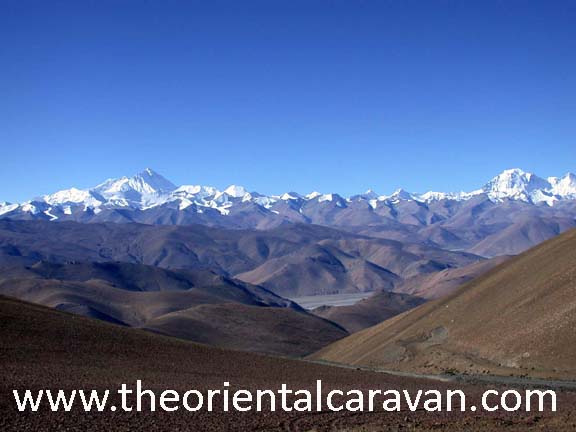 To get to this bus stop, we first go over Pang La, a mountain pass (5220m). The view from Pang La is absolutely amazing. There's a partial picture (stolen from the web; mine are trapped on the camera) to the right. On the left is Chomolangma (aka Everest). On the right is the lower summit of Cho Oyu, 8201m (6th highest peak). Hidden behind Everest is Lhotse, 8501m (4th hightest in the world). What you don't see is Makalu, 8462k (5th hightest) , further to the left. Makalu is one of the most gorgeous mountains the world.
Anyway, I jumped out of the Land Cruiser, saw the view (it was crystal-clear) and nearly crapped myself with joy. There was much photography, believe me.
Fast forward to Rongbuk. We arrived 12:30-ish, got a room at the monastery's guesthouse and had lunch. Caroline, Demelza & myself were bent on walking the 8km to the base camp itself. Megan was being her whiny self and didn't seem keen to go, probably because she is weak, out of shape, and spoiled. But she wasn't about to ride the horse cart on her own, so walking she went. Oh, and the view from Rongbuk is really quite stunning. Google "Rongbuk Monastery" if you don't believe me.
I should point out that I walked faster than these three girls. Why? Because I am in shape and excited. Anyway, part way up the walk, as I was taking a little rest, I met up with two fit-looking guys making their way briskly up the dirt path. Turns out Mathieu and Vince are both Canadians, and both climbing the 8848m rock pile ahead. They have both already slept at 7500m. They are in shape. Acclimatized. Much more so than I in both respects - but I put on a valiant effort of keeping up (only stopping to say "yo, guys, hold on and let me catch my breath" about twice). As soon as we got to base camp, I collapsed on a rock and ate a Clif bar in an attempt to refuel my body.
Base camp itself is divided into two parts: teahouse city and tent city (names invented by me). Teahouse city is closer, and consists of about 20 big A-frame tents that serve tea & food by day and sleep people by night. Mathieu & Vince recommended Hotel California, and that's where we all went.
At Hotel California, we also met Patricio (aka Patrick), an Ecuadorian climber who's apparently getting speeding tickets on Everest because he's covering ground way too quickly. Faster than a speeding Sherpa! Smarter than a locomotive! More powerful than... a speeding Sherpa! To be fair, I actually met Patricio when ventured out to find Mathieu and ask him for some painkillers for Caroline, who wasn't doing too well at the altitude (5200m). He's recognizable by the huge number of sponsor-patches he has on his shirt.
Patricio is one of the most genuine, down-to-earth, good-natured individuals I've ever met. He needed a ride to Shegar the next day to have a rest break before going for a summit push. We agreed to try to help him, if our driver Dawa cooperates. We're all friends forever - at least pair-wise friends with Patricio, since Megan is one of those people I'd rather cut out of my life.
Anyway, Hotel California was so cool, we spent the evening and night there. Interesting things that happened after sundown include:
- Megan ventured out to relieve herself, with Caroline as a human shield, and discovered that some Tibetan was staring at her in close quarters.
- Megan proceeded to run to the tent as quickly as possible.
- 15 minutes later Megan says "why does it smell like shit here?" and realizes that she has ordure on her shoe.
- 3 seconds later Alex starts laughing.
Anyway, I was a gentleman and went outside into the bitter, punishing cold to shine my headlight on Megan's shoe as she cleaned the unidentified ordure off as best she could. It was very amusing to watch.
That night we slept at Hotel California. I fell asleep to the sound of Tibetans having a party outside, in the bitter punishing cold. Patricio went out to videotape them. I wasn't dressed for the occasion and stayed inside comforted by a warm down blanket, a nalgene filled with hot water, and my fleece.
The next morning, May 9th, I saw Everest bathed in morning light and took a lot of pictures while enduring the bitter, punishing cold. It should also be noted that May 9th-10th is the 10-year anniversary of the 1996 Everest disaster well-documented in books such as Into Thin Air and The Climb and Left for Dead.
We left Rongbuk at around lunchtime and drove to Lhatse for an overnight stay. Not much to say about Lhatse. Patricio got a ride into Shegar, and we watched a climber eat the equivalent of four people's food by himself. It was a sight to see.
Incidentally, Patricio invited us all to Ecuador. I might take him up on that for maybe a 2-week vacation that would include a climb of Cotopaxi or Chimborazo or something. Oh, and a trip to the Galapagos. Wow!
I wish Patricio, Mathieu and Vince all the best and hope they all summit safely.
Final thoughts: Staying at Everest Base Camp was one of the coolest things I've ever done. If I had more time and more equipment (ie warm clothes and crampons), I would have tried to find a way to go up from base camp to Advanced Base Camp at 6400m. That'd require at least another day of acclimatization at 5200m, a day going up, and a day coming down. But... how cool would that be?
May 7: Shigatse to Shegar
On May 7 we took a jeep from Shigatse to Shegar. If Shigatse is a hellhole, then Shegar is the armpit of the universe. Our hotel was super-sketchy (even though it's a fancy new-ish Chinese deal) with no hot water, no heating (of course) and a lot of scaryness. For a while it looked like we four were the only ones there. Ahem.
After we checked into the hotel I decided that sitting around, playing cards, and enjoying the hellhole wasn't for me. Shegar apparently has a monastery from which you can see the top of Everest. Now is a time to explain the geography of Shegar.
Shegar itself is located 7km off the Friendship Highway, which links Lhasa with Zhangmu on the Nepali border. West of Shigatse, the Friendship Highway is not a highway. It is a dirt road with deep ruts, occasional streams to be forded, and lots of bouncing around in the jeep. If you don't have a 4x4 such as a Toyota Landcruiser don't even think about trying this road. Really.
Anyway, we stayed not in the town of Shegar itself, but in the ghetto of hotels that sits on the Friendship Highway at the turnoff to Shegar. The monastery at question is actually in Shegar.
What am I getting at? I wanted to go to this monastery not aware of the geography of Shegar, and not realizing that the damn thing was 7km away. I set out around 7 PM, walked along the road after I asked someone "Shegar gompa??", looked puzzled, and saw them point up the road. After 30 minutes of seeing nothing resembling a gompa I turned back and decided to climb the spur that was overlooking the hotel ghetto at the side of the Friendship Highway, which is what I'm getting at.
I was sitting part way up this pile of rock, scree and crap. I decided to come down. I look over... and a little Tibetan kid is running towards me! WTF mate! Turns out this kid, named Gyunda or Junda or something, lives nearby and likes foreigners. We had a mountaintop lesson in English, where he learned words like "jacket" and "shoe" (his were falling apart) and I re-learned words I already knew like "ri" (mountain) and "stupa" (err... it's a stupa!). The kid was dirty, scruffy, 12 years old, and very sweet like most Tibetan kids. Also, like most Tibetan kids, he really needs a bath. I don't think they bathe around here, which is somewhat understandable given the desert-climate and consequent lack of water.
Anyway, Gyunda followed me to the hotel and I gave him a chocolate bar and a pen, which he was delighted with. I hope he gets out of Shegar and does something with his life.
Saturday, May 06, 2006
May 6: Shigatse
Shigatse's major attraction is Tashilhunpo Gompa, seat of the Panchen Lamas and currently the biggest monastic centre in Tibet. The monastery itself is quite nice, although it feels like Sera, Drepung, Samye, Yumbu Lakhang and every other monastery. It's quite big, though not as big as Drepung (the biggest in the world, after all). One of the attractions is a 26m bronze statue of Maitreya Buddha, the Buddha of the Future. According to the guidebook, this is the biggest such buddha in the world - the ones that are bigger aren't metal, I think. It's quite impressive, and has a building all to itself.
The monastery also has some very ornate tombs for past Panchen Lamas, the latest having expired in 1989 just 3 days after coming to Shigatse from Beijing for some sort of ceremony. He made good on his promise to die on Tibetan soil. His replacement, the 11th Panchen Lama, is the subject of controversy since there are two candidates. One is "official", the other is apparently under house arrest. You be the judge of how that came about.
Other than that, Shigatse is a boring little city with not much to show for it. Parts of it are very Chinese and not very Tibetan. For instance, the restaurant where we had dinner was a joint not unlike the jialzi restaurants I've visited in China before coming to Tibet. Its only redeeming qualities is that there is a lively Tibetan outdoor market, and the internet access in this China Telecom internet bar seems to be pretty fast. Otherwise, the place is a bit of a hole. Dusty and grim.
I'm having a neat time with my travel-mates. Megan, in particular, is proving to be quite the character and it seems like I'm not the only one who finds her a touch hard to swallow. She seems a bit scatterbrained, somewhat whiny, always complains that we're walking too fast (when we're not), constantly talks about sex and about her Chinese boyfriend (who I immediately placed into the "fob" category after seeing a picture), and seems to lack a certain seriousness and maturity that I see in Caroline and Demelza. Maybe it's the fact Caroline and Demelza both went to university and had a chance to season a little bit. Not that I'm being judgemental - that's not me at all!
On the plus side, I'm getting along famously with Caroline and Demelza. Sometimes it feels like we're ganging up on Megan, but in all fairness I think she brings it on herself by taking the piss out of the rest of us all the time. For whatever reason, she insisted on staying in my room tonight, possibly to drive me crazy. We'll see.
Tomorrow we are off to our next stop. While we were on our way to Shigatse I looked at the map and the guidebook and decided that it'd be best if we went to Tingri instead of Shegar. Tingri is probably 2 hours' drive farther down the Friendship Highway, and we'd have to travel that distance back to hit the turnoff to Everest.
Why do this? Acclimatization. Shegar is the same altitude as Shigatse. Tingri is 400m higher. The next stop after Tingri/Shegar would be Rongbuk Monastery at 4900m and Everest Base Camp at 5200m, which I think might be a bit of a jump. Instead of Shegar, we'll stay at Tingri at 4400m and have two smaller overnight elevation gains to try to distribute the impact. Hopefully this will be more gentle on the body.
I don't think being extra-cautious with acclimatization is a bad idea at all. I've now had the occasion to watch a bunch of tourists arrive in Lhasa and struggle, although I've been feeling largely a-okay. Plus, there's the factor that my three travel mates aren't very well acclimatized at all. Megan in particular doesn't seem to be doing well; she's moving quite slowly compared to the rest of us and seems to be super-tired much of the time. It would be no fun to arrive at Rongbuk and find that someone (maybe me) is suffering from severe AMS, or worse.
Anyway, I'm excited because the morning after tomorrow's I will hopefully see the Himalayan giants Everest, Lhotse, Cho Oyu and Makalu, all visible from the top of a 5200m pass on the way to Rongbuk. Hopefully I will be up to the task of walking the 8km from Rongbuk Gompa to the base camp. If not, I understand there's a horse you can ride for those 8km...
I doubt there is internet access in Tingri, which promises to be even more depressing than Shigatse, with a guesthouse that is nowhere near as nice our hotel here. In other words, this might be the last update until I am back to Lhasa in the evening of May 10th.
Friday, May 05, 2006
May 5: The Old Road to Gyantse
The road there is, in a word, stunning. First stop: Yamdrok Tso, an alpine lake at 4500m, by way of a 4800m pass, the Kamba La. The weather didn't cooperate fully and we had a bunch of clouds and rain and hail and other excitement. However, the views we got of the lake were pretty amazing.
The road continues through the village Nangatse and then into some canyon-gorge-like terrain that is totally out of this world. Most of the road is at over 4000m, and many of the peaks nearby are covered with snow, or have hanging glaciers. You're on the side of a mountain for several hours. This place needs to be seen to be appreciated.
Gyantse itself is nothing special, althoug there is an old fort here, Gyantse Dzong. This is the site of a pretty important battle between Col. Francis Younghusband and the local Tibetan army in 1904. The battle was a rout for the Tibetans, with the Brits slaughtering several hundred in just minutes. The brits were battled-hardened soldiers with the best gear. The Tibeans had... slingshots.
There's a place at the fort where, apparently, the remaining Tibetan fighters jumped off the cliff (the fort is on a big hill) rather than surrender to the British. Something like Thermopylae, maybe? Or Masada?
Anyway, the Dzong ("castle" or "fort") is pretty interesting and well-worth the climb up. Great views of the city and the nearby mountain ranges.
Incidentally, even though I am not really suffering from the altitude at the moment, my jeep-makes are to varying degrees. One girl, Megan, had to give up on the Dzong and head back to the hotel - way too tired, not able to move, etc. Not good. I have the benefit of having spent more time in Lhasa than these girls, took Diamox when I got here, seem to be sufficiently fit, and maybe don't suffer from altitude as much. It's fortunate. However, we'll see how it goes tomorrow and the next day, when we sleep at higher altitudes. Gyantse is at 3800m, not much higher than Lhasa. It is, however, way the hell colder!
And speaking of the girls..... they're really eager to bust my chops. Megan in particular. I don't know how much patience I have for an impudent 20-year-old, although so far it's certainly all fun & games.
So, a quick bio of my travel-mates:
- Caroline, 25, from Abitibi QC. Good fun.
- Demelza, 22, from Sydney - also good fun, but pretty quiet.
- Megan, 20, from Edmonton - runs the risk of getting on my nerves and being subject to the treatment in CICA HB3062 - although I doubt it'll get to that point.
Thursday, May 04, 2006
May 4: Bummin Around
The important things that happened are:
- I am for sure going on a trip to Everest tomorrow, with three girls.
- I purchased a Mountain Hardwear windproof fleece for $20 CAD. I think it's real, because it has a 1500-kwai price tag (~$200 CAD) from some other Chinese retailer, which is what these things should cost. I also can't notice any obvious signs of fakery. The only thing I notice is that the elastics that tighten the waist and neck are a bit too stretchy. Minor defect. Boo-hoo.
The Everest trip itinerary is as follows:
May 5: Drive to Yamdrok Tso, an alpine lake of supposedly staggering beauty. Hang out there for a bit. Drive to Gyantse (pronounced djantze) for an overnight at some guesthouse.
May 6: Drive to Shigatse (pronounced shigatze) for an overnight, and visit the Tashilumpo Gompa, seat of the Panchen Lama, while we're there.
May 7: Drive to Tingri (a tiny settlement in central Tibet) as an acclimatization stop. Stay there to bum around and get used to higher elevation.
May 8: Drive to Rongbuk, visit the base camp and the monastery. Stay overnight
May 9: Drive to Lhatse (another small town) and visit the Xiqing (pronounced shiching) Hot Springs. Mmmm hot springs....
May 10: Return to Lhasa.
I leave Tibet May 12.
I will likely have very limited access to internet after we leave Shigatse. Gyantse and Shigatse are the third and second largest cities in Tibet, respectively, and I expect there will be something of an internet cafe there somewhere. I hope. Maybe I'll be able to update this blog, but maybe not. I'm pretty sure that Tingri, Rongbuk and Lhatse have no internet access, but China has surprised me before so who knows?
On the other hand, I've been told that that cell phones work in these remote areas... we'll have to see.
The Monk's Book...
Wednesday, May 03, 2006
May 3: Drepung Gompa & Good Times
I met another travel agent. I am (supposedly) going to Everest tomorrow. More on this later.
At around 2 PM Julien called me - evidently his plans fell through and he's going on another trip tomorrow. He said "dinner at 7 and I'm going to Drepung now". I joined him on a trip to Drepung Gompa. Gompa is Tibetan for "Monastery".
Drepung was at one point the largest monastery in the world, a home to 10000 monks. The place is huge and imposing, built on the side of a mountain, and very impressive. We got there late in the day, so many of the chapels were closed - good enough for me - although we did get to see monks in mass-mantra-mode inside the Tsokchen, the main assembly hall. Since some of the tourist-oriented parts (ie the chapels) were closed, we had more time to roam the grounds and look around.
We roamed for a while when we bumped into a construction crew of monks, who were digging some stuff and moving earth and making a big commotion. They called us over to take pictures. Very friendly guys. We're all smiles and "tashi deley!! tashi deley!!" and they're all smiles and pantomiming the camera and stuff.
Then they invited us in to have butter tea and eat their food. I had a bit of butter tea the day prior, and it was nothing like this stuff. So strong. So rich. So salty. OMFG. Anyway, I got a handle on it, and it goes okay with the tibetan bread (also very heavy) and their eggs (fourth egg of the day - I'll be dead of cholesterol!). Mmmm..
But really, the experience was sitting and eating with the monks was what this was all about. Their chief English-speaker (whose English was only a little bit better than my Chinese or Tibetan) was great conversation, and I figured out the following facts:
- His name is Sangye Gyantso
- He is 24 years old
- He's Tibetan
- He's a monk.
Two of the guys, Sangye and another one, were wearing football jerseys. I had some Canadian on me (two lapel pins), so I pinned them on the guys. Sangye was wearing a French national team jersey so he became a French Canadian. His friend was wearing a Manchester United jersey - he's now an English Canadian. They were very impressed.
Sangye taught me some Tibetan, counting & stuff. The pronounciation is quite hard, much like in Chinese. However, what I didn't expect was for Sangye to take me into his bedroom to show me letters he's received and his photo album. He also had a copy of an English book (whose name sadly escapes me at the moment, since I'm in an internet cafe and it's in my room) translated into Tibetan, with both versions printed together. I looked at it in wonder. Then he gave me the book. I knew that if I didn't take the book, he'd probably be offended. Besides, how do you politely say no to a monk who's trying to be extremely generous to a perfect stranger?
I am totally and completely touched. For people who have so little by our standards, they give so much and so freely. It's pretty amazing. I will send them prints of the pictures I took at Drepung Gompa. It is the least I can do.
Eventually, after more pictures, more "tashi deley!!" and more smiling and laughing with these construction-monks, we left for dinner.
Dinner, in this case, was 6 girls and 3 guys. There were many Canadians present, the largest such concentration I've seen since arriving here. My Everest plans changed there & then, since it turns out that three of the girls are going on a 6-day trip to Everest (with a detour at the local hot springs!) on Friday. And they want a fourth to split the cost of the jeep.
Yup. A Quebec girl, a Western Canada girl, and an Australian girl. In a Land Cruiser. For six days. I dig it.
Assuming this doesn't fall through (and I don't think it will) we leave the day after tomorrow, ie May 5th.
Neither of my travel agents for the trips that are leaving tomorrow (and that I was looking into and said "if the people are good, I will come") have called me today. I called one and he said "I'll call you back" and never did. I'm not impressed, and I'm willing to get in doubt in a big hurry.
Tuesday, May 02, 2006
May 2: Samye Monastery
There are three stories here: one of the bus ride there, one of the monastery itself, and another of the return journey.
The trip there was punctuated by an unlikely passenger on our minibus. A cat. In a box. Meowing loudly. A meter from my head. Now, cats are hardy creatures and if they are trapped in a box they won't like it very much. This one managed to force a hole in the (taped up) box with its head, crawled out, and proceeded to crawl around the bus. 30-odd Tibetans (overcapacity, sitting in the aisle, etc), two white guys, and an orange cat. On the way to a monastery. Who'd have guessed?
Samye is about 180 km away, but because of the geography here we had to make a long-ish detour through Tsetang, a "city" the size of, say, Stayner. Plus, the roads here suck. Oh yes, and for about 2 hours of the trip the bus driver was playing a tape of mantras. Loudly. Tibetans were mantra-ing along. I was trying to sleep. The trip there took 4.5 hours.
Samye is simply gorgeous. The compound is walled in, and shaped like an Indian mandala. The central building, the Utse, is a three-story affair with each floor carrying its own style (Tibetan, Han Chinese and Indian, respectively). The story goes that King Trisong Detsen (Tibet's greatest king, who brought Buddhism here) invited Indian masters Padmasambhava and Shantarakshita to promote buddhism, and they set up the monastery at Samye. Anyway, i's very important, very scenic, and quite remote.
After touring the monastery for a while, Julien & I went up Hipo Ri, a nearby hill (vertical of maybe 200-300m, no more) that has religious significance in that it is said that this is where Padmasambhava defeated the local spirits and won them over to Buddhism. On the top of the hill is a small building, and inside I found a chanting, mantra-reciting Lama minding his own business. Very cool.
While we were in the Utse a very friendly PSB officer (a Tibetan guy, maybe 20 years old) politely asked to see our permits. We apparently needed permits for this area. I knew about this, and I also knew that they often don't check, nor do they issue permits unless you're part of a tour group (we weren't). I played stupid and he more or less left us alone, no fine, nothing. I think he knew what the story was and was happy to discharge his duty by looking at our passports. No problem.
The trip back is where the plot thickens, really. We left at around 2:30 (after arguing with some opportunistic ticket collector who wanted 200 kwai per ticket, instead of the 40 kwai it should cost). I thought it'd be another 4-4.5 hour trip back to Lhasa, direct. Nope. We stopped at two monateries on the way, each time for "10 minutes" that somehow ended up being 30 minutes. The first one looked like nothing special. The second, Yumbu Lakhang, is a reconstruction of a 2000-year "palace" built by the first king of Tibet, Nyatri Tsenpo. The original was destroyed during the Cultural Revolution (thanks, Mao!). The monatery itself is perched on a rock spur high above the local valley. The view is spectacular.
The trip to Tsetang, and the visit to the two monasteries (just outside Tsetang), took us until 5:30 PM. That's three hours! Of the original estimate of 4.5 hours to return to Lhasa!
The trip from Tsetang to Lhasa took another 3 hours. Important observations about this trip:
- Whereas some Tibetan music is nice, what our driver was playing (loudly) sounded like a mixture of a cat in heat, Bjork, a fax machine, and a bad opera singer.
- While drivers here are aggressive (they cut people off at will and use pedestrians as target practice) they'll drive SUPER SLOWLY on empty, rural well-paved roads. Roads I would drive at 120km/h in Canada get covered at 60km/h here. (@%#*%()@!#*&%!)(*%!!!
- The guy who sold me the tickets to Samye the day before told me we'd be back in Lhasa at 6-ish. We got back at 8:41. I was a little pissed off because I expected to have some time to figure out my Everest trip in the evening. We ended up eating a very late dinner.
Also, whoever claimed that Tibet is a plateau wasn't looking at Lhasa. It might be a plateau in the sense that there are lots of flat valleys. There might be flat platueau-like areas elsewhere. However, Lhasa is surrounded by mountains on every side. The airport is an hour's drive by bus, through a tunnel under a mountain. The tunnel opened last year and cut the trip to the airport by half. The geography is not very conducive to travel at all. It's not the prairies. It's not the Golan Heights. It's a bunch of mountains!
Anyway, I'm going to try to figure out my trip to Everest now. Time to see some travel agents.
Monday, May 01, 2006
May 1: Jokhang & Sera
My impression? The Tibetans place a lot of value in imagery. They come to the Jokhang, prostrate themselves in front of it, do koras, and generally worship the contents. Inside, you find a lot of statues of Buddha Shakyamuni, Padmasambhava, Milarepa, Chenresig and other boddhisatvas whose names I cannot remember. The place is filled with gold statues, ornaments, and donation plates. It's quite overwhelming, actually.
Unfortunately, the majority of the chapels inside were closed and I didn't get to experience the satisfaction of tour groups pushing me inside a tiny, claustrophibic chamber with some statues.
One thing I noticed is that most of the devout Buddhists are either old or crippled. Murray explains this as these people realizing they are at the twilight of their lives and feel the urge to build up as much good karma as possible, since time is running low. There are not many Tibetans in (say) their 30s, postrating in front of the Jokhang for hours on end. But there are plenty of 80 year old Tibetans spinning their prayer wheels.
Another thing I notice is that this is, without a doubt, the most religious place I've ever been to - including the Vatican, where you see a lot of Catholic symbology and opulence and procedure but that's where it ends. Here, there's an air of faith and devition. You can't turn around without seeing a monk along the way. You can't stroll through the Barkhor without seeing someone prostrate. There are small shrines everywhere (some of them quite intimate) and it seems that Buddhism is a way of life for a great many people. Of course, many of them are old.
In the afternoon, I took a trip to Sera Monastery, north of Lhasa. This was one of the major schools of Buddhism in Tibet until the Chinese invasion, and especially until the Cultural Revolution. Fortunately, Sera was largely spared from the carnage. It's a big monastery, built to house around 5000 monks (and that's how many it held - until 50 years ago or so), and is now home to maybe 500. What a difference.
The main reason to go to Sera is to see the daily Monk Debates, every afternoon at 3-ish. You see monks congregating in pairs or small groups, where one monk stands up and makes points. Whenever they make a point, they ritually slap their hand and a big heavy stomp of the foot. I figure the harder the slap, the more important the point. If it's a double-slap, you get a debating bonus. The courtyard where this is held degenerated into a mob of saffron-robed monks (most of them pretty young) slapping their hands mercilessly and yelling in Tibetan. They were, in turn, surrounded by a mob of camera-wielding tourists who find the whole thing amusing. I took pictures, since I'm a camera-wielding tourist and should uphold that reputation where possible.
Some observations:
- This might be the only funny thing about Tibetan Buddhism.
- The whole thing might be just for the amusement of the camera-armed tourists.
- The older monks are a lot less excited about this debating business - they sat in their own corner of the courtyard and looked lazy, cause they have all the answers and don't need to debate any further.
- When there's a firey debate going on, you know it. I was watching one triumverate where one of the seated monks was arguing rather forcefully, pointing fingers, yelling & screaming at the standing monk. The other seated monk had to restrain the boisterious one on a few occasions. It was definitely very amusing.
- I think the Chinese view the camera equipment they have as a status symbol, like a car in North America or a watch in Switzerland. Everyone seems to be carrying the top of the line digital SLRs and big, fancy lenses. I wonder if they know how to take a good picture, of if they hope that the technology will make up for a lack of talent. I, on the other hand, have neither top-dollar equipment nor any talent, so I'm winging it as I go!
Another thing I noticed is that all the statues of the various Boddhisatvas have one of two expressions in their eyes:
- Big-eyed shock & amazement - their eyes look like Arnold Schwarzenegger's in Total Recall when he ends up in the vacuum and seems to be blowing up from the inside, until the air comes out of the underground storage vat and Mars is saved.
- Evil squinty-eyes - the kind of eye you'd give to someone you have a lot of contempt for. Not that I know anything about having contempt for some others....
It seems that there are no other facial expressions in Buddhism.
I'm getting a bit templed-out, and to make the situation worse I am going to Samye Monastery tomorrow. Why? Because Katie recommended it, and I'll take good advice from clued in people. Samye is a 4-hr drive east of Lhasa. Julien & I are going there & back tomorrow. It's a good diversion.
Also, I'm likely going to Everest Base Camp as of May 4th, for 4-5 days (it better be 5 days!). I met with a driver who's taking some other people there earlier today, and his plan was to drvie from Shigatse to Rongbuk & the base camp in one day, an 8-hr drive and a 1200m ascent. As soon as I heard that plan I decided that whoever's planning this clearly doesn't have respect for altitude. I found another agency that was advertising that they need two other people to fill a jeep going to Rongbuk, this time with an acclimatization stop in Tingri (halfway up between Shigatze and Rongbuk). I told the guy there to check who the other two people are to make sure they're not some non-English-speaking Chinamen who'd make my trip an exercise in counting the potholes on the road between Lhasa and Shigatse.
Oh, and there is a place here called The Summit Cafe. It's run by some Western types who've been living in Lhasa for 3 years. They serve espresso, scones, cinammon rolls, and seem to attract the Western traveller crowd. I like it, although it is expensive (a common theme in Lhasa - but that's not surprising given that this place is super-remote). Right now they're playing Loreena McKennitt (go Canada!!!) and earlier they were playing Enya. It's refreshing.
Anyway. Samye tomorrow. Will report once I'm back.
